
Equipment
Types of running shoes: how to choose for training and racing.
Running shoes have changed considerably in recent years. More responsive foams, high-stack midsoles, stability structures and carbon plates have become features of various models. But more technology does not necessarily mean a better shoe for every runner. The choice should mainly take into account the purpose of the workout, comfort, the runner’s adaptation and the type of race. For beginners, comfort and adaptation are usually more important than seeking out the most advanced technology. For experienced runners, lighter and plated models can make sense, particularly for specific workouts and races.
Translated from Portuguese
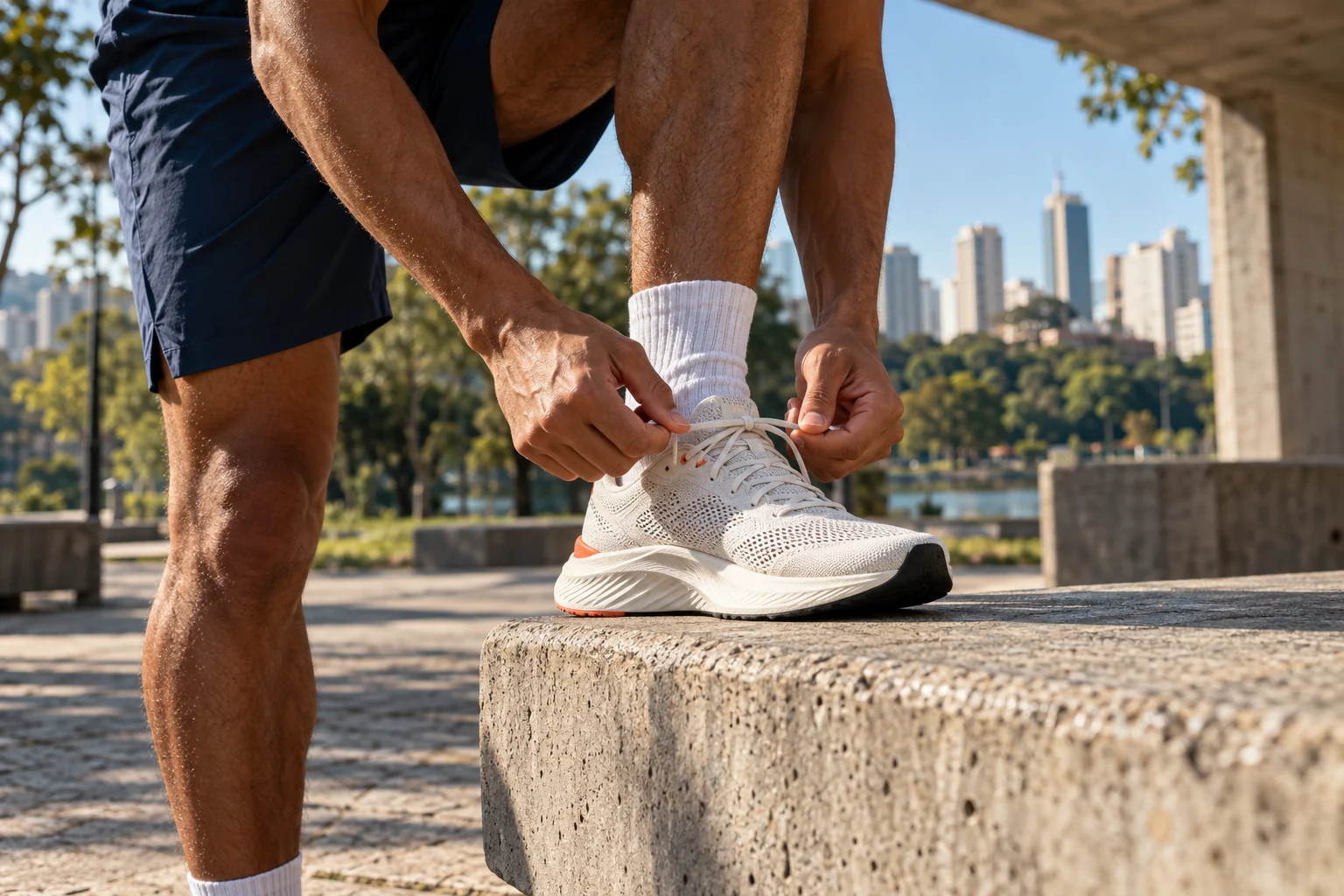
Choosing a running shoe may seem simple, but today there are dozens of different technologies and categories.
Some models offer plenty of cushioning, others are firmer, and there are lightweight shoes for fast workouts, models with carbon plates and stability-focused options. There are also shoes that use different types of foam, including materials developed to provide greater energy return.
Problems arise when these features are treated as if they alone determine which shoe is best or which model will prevent injuries.
The scientific literature does not support such a simple rule. Studies show that footwear changes running biomechanics, but there is still uncertainty about how much each feature influences injury risk. A Cochrane review, for example, found low- or very-low-certainty evidence for several comparisons between different types of running shoes. [1]
That is why the best choice depends on the runner and how the shoe will be used.
Daily trainers: the most versatile choice
For most runners, a daily trainer will be their main pair.
These models are usually built to balance comfort, protection, durability and performance. They may be softer or firmer, lighter or more structured, but their sole aim is not to achieve the fastest possible race time.
They are particularly useful for:
- easy runs;
- long runs;
- weekly mileage;
- recovery;
- beginner and intermediate runners.
If you are just starting out, there is no need to look for a racing shoe straight away. A comfortable model that fits well and suits the shape of your foot may be a more sensible choice.
What about the well-known “gel” cushioning?
“Gel” is primarily a commercial name for a particular approach to shoe construction. It should not be interpreted as a separate category of running shoes or a guarantee of greater protection against injuries.
What matters is the complete package: midsole foam, shoe geometry, stiffness, weight, fit and how the shoe feels while running.
The same applies to other cushioning technologies. A softer midsole can change forces and perceived comfort, but that does not automatically mean a lower injury risk.
Carbon-plated shoes: who are they right for?
So-called “super shoes” typically combine a highly responsive foam, a specific geometry and a stiff plate, often made of carbon fiber.
The plate does not work on its own.
A systematic review and meta-analysis published in 2026 found an approximately 2% to 3% reduction in metabolic demand when running in plated shoes. However, the authors themselves stress that this effect cannot be attributed exclusively to the plate, because these shoes combine different construction features. [3]
In practice, this means a plated shoe may be useful for:
- races;
- tempo runs;
- interval sessions;
- runners who have already adapted to the model.
For a beginner, however, there is no requirement to use a plated shoe. It can be expensive, have construction features that require adaptation, and it does not replace progress through training.
Furthermore, current evidence does not support the claim that the plate alone increases injury risk. The issue is more complex and involves the interaction between footwear, training load and the runner’s individual characteristics.
Stability: does everyone need to control pronation?
No.
Pronation is a normal foot movement during running. A runner having more or less pronation does not, in itself, mean there is a problem that needs correcting.
Stability or motion-control shoes can change some aspects of running mechanics. Some studies have even shown a reduction in certain pronation-related injuries in specific groups of runners. [4]
But that does not mean every runner should use this type of footwear.
The Cochrane review also found insufficient evidence to claim that choosing shoes based on static foot posture reduces injuries in runners overall. [1]
The most important factors to consider are comfort, injury history, adaptation and the individual response to the shoe.
Training shoes and racing shoes
Having two pairs can be useful, but it is not essential.
An intermediate or advanced runner can use a more comfortable, durable shoe for most training and reserve a lighter or plated model for certain workouts and races.
This can offer two advantages: preserving the more expensive shoe and allowing the runner to gradually get used to the racing model’s characteristics.
On the other hand, there is no need to build a collection of shoes to start running.
For a beginner, a good daily trainer is enough.
Which shoe should you choose at each level?
Beginner
Prioritize:
- comfort;
- a good fit;
- a feeling of security;
- gradual adaptation;
- a model suited to daily use.
You do not need to buy a plated shoe to get started.
Intermediate
At this stage, it can make sense to have a main daily trainer and, depending on your goals, try a lighter model for fast workouts or races.
The transition should be gradual. If the shoe’s construction is very different from your usual model, it is worth initially using it for short sessions.
Advanced
For more experienced runners with competitive goals, shoes with plates and higher-energy-return foams can be a useful tool.
At this level, it makes more sense to think of footwear as part of a racing strategy, rather than simply trying to find the “most high-tech” shoe.
What about durability?
There is no universal number of kilometers that determines when a shoe needs replacing.
Wear depends on the model, the runner’s weight, the surface, frequency of use and the shoe’s construction characteristics.
More important than looking only at mileage is watching for signs such as:
- excessive outsole wear;
- visible midsole deformation;
- a noticeable loss of comfort;
- a significant change in how the shoe feels while running;
- recurring discomfort that was not present before.
A shoe does not need to be discarded simply because it has reached a certain number of kilometers, just as it should not continue to be used indefinitely simply because it still looks intact.
So, what is the best shoe?
There is no single answer.
For most runners, the best shoe combines comfort, a good fit, adaptation and suitability for the type of training.
For someone just starting out, that probably means a good daily trainer.
For someone already training regularly, it can make sense to combine a training model with a lighter one for specific sessions.
For those who race and seek performance, plated shoes and advanced foams can offer measurable advantages, mainly related to running economy. But these advantages do not make the footwear a universal solution.
Technology can help. It does not replace adaptation to training, recovery and an individualized choice of equipment.
Conclusion
The evolution of running shoes has brought important benefits to the sport, but it has also made choosing more complicated.
Cushioning, stability, foam, weight and carbon plates can change the experience and mechanics of running. Even so, the evidence does not support the idea that any type of shoe can prevent injuries for every runner.
For beginners, simplicity is usually enough. For intermediate runners, it is worth starting to distinguish between training and performance shoes according to their goals. For advanced runners, technologies such as carbon plates can be used strategically.
Ultimately, the best shoe is not necessarily the most expensive, the softest or the most technologically advanced. It is the one that makes sense for you, for that workout and for that stage of your running.
References
- Relph N, et al. Running shoes for preventing lower limb running injuries in adults. 2022.
- Sun X, et al. Systematic Review of the Role of Footwear Constructions in Running Biomechanics: Implications for Running-Related Injury and Performance. 2020.
- Kobayashi EN, et al. Metabolic effects of carbon-plated running shoes: a systematic review and meta-analysis. 2026.
- Willems TM, et al. Motion-Control Shoes Reduce the Risk of Pronation-Related Pathologies in Recreational Runners: A Secondary Analysis of a Randomized Controlled Trial. 2021.
Related questions

Beginners · First 5K
How to start running from zero: a complete guide to your first 5K

Technique · Biomechanics
Running cadence: is there an ideal step rate?

Training · Pace